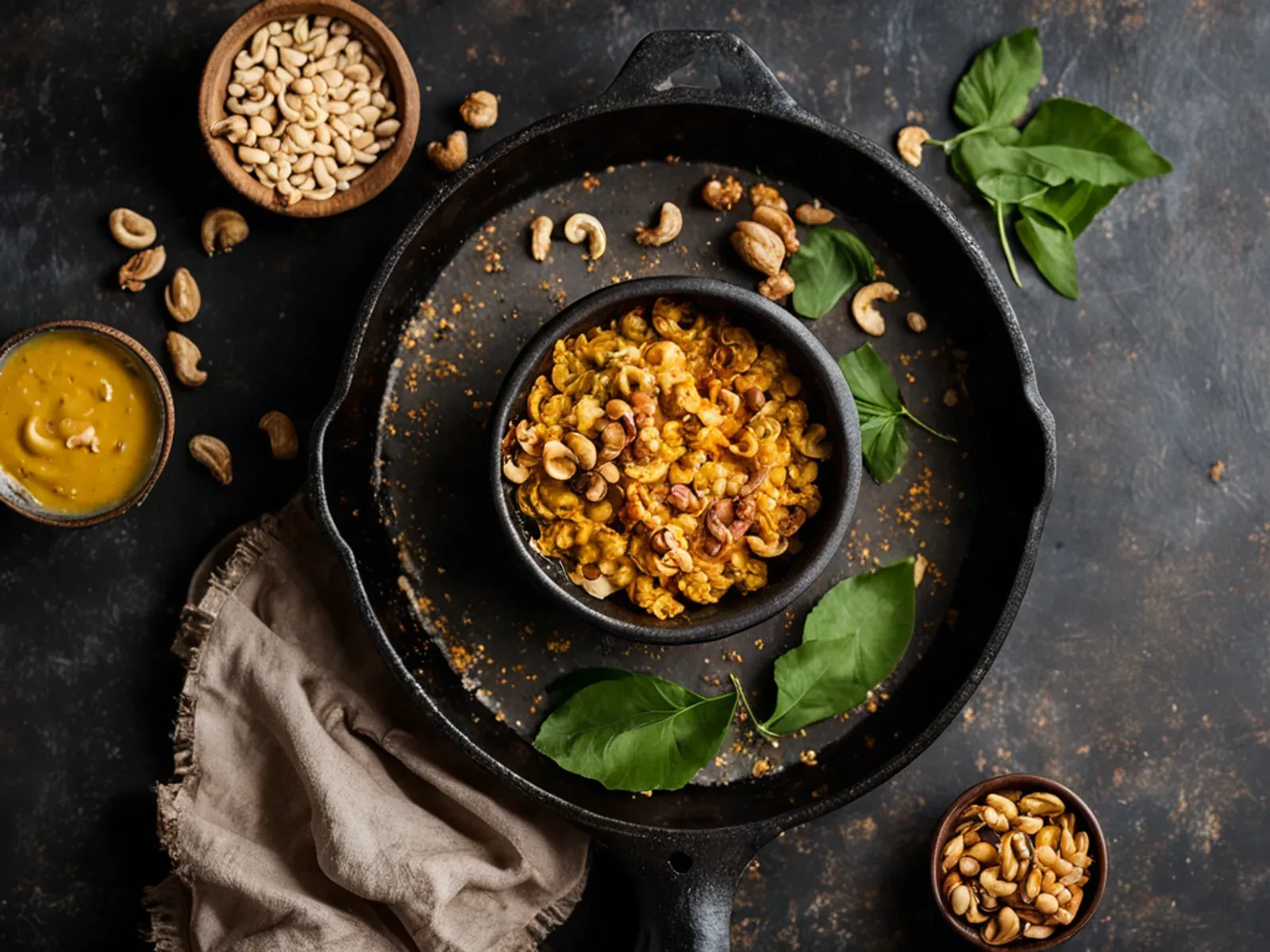
No-Fry Roasted Poha Chivda with Peanuts, Cashews, Coconut and Curry Leaves
This poha chivda recipe skips the deep fryer: thin rice flakes are dry-roasted until crisp, then tossed with spiced peanuts, cashews, coconut and curry leaves.
- Prep
- 5 min
- Cook
- 20 min
- Rest
- 20 min
- Serves
- 8
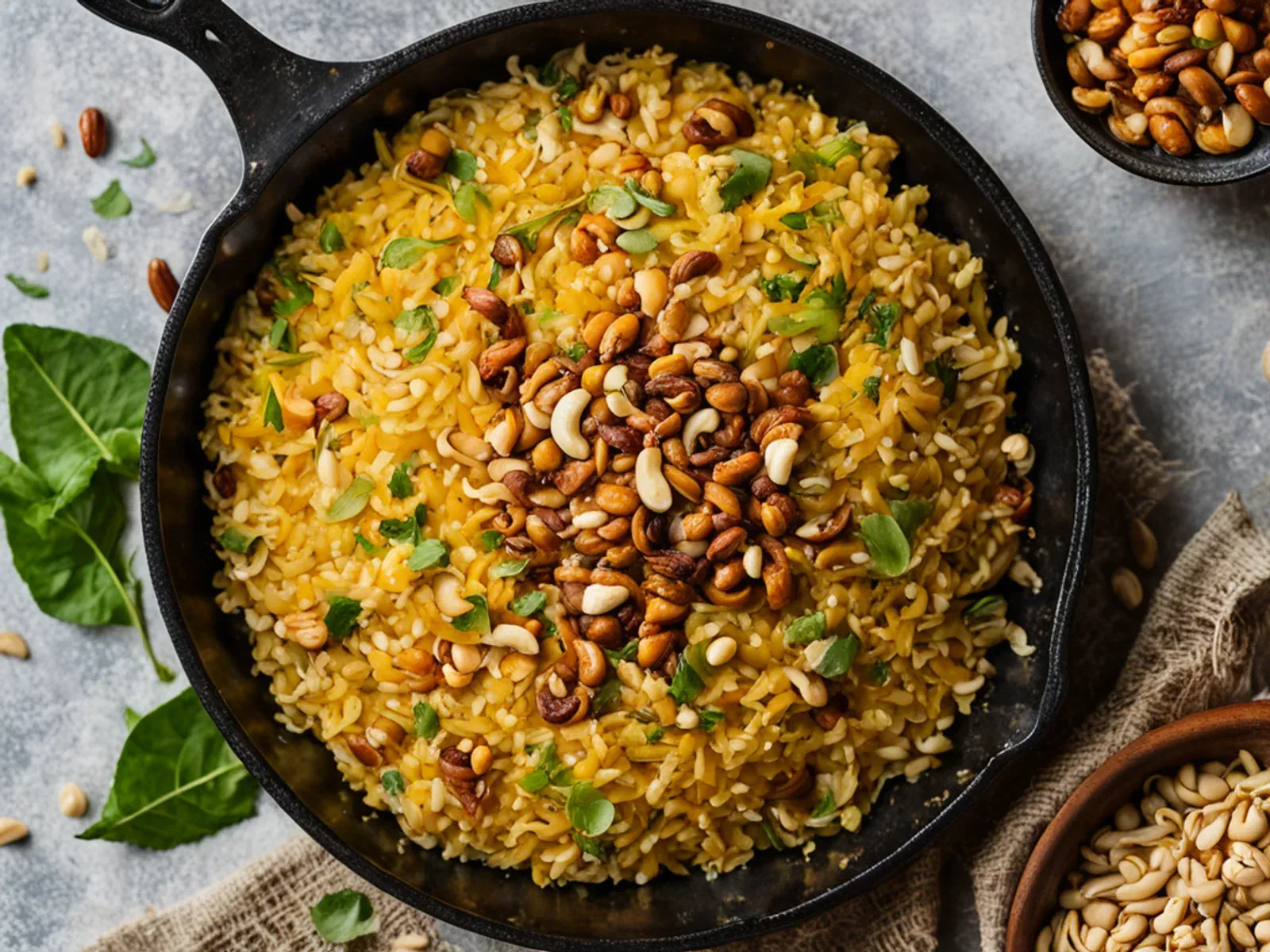
No-Fry Roasted Poha Chivda with Peanuts, Cashews, Coconut and Curry Leaves is a vegan snack recipe made with thin poha (flattened rice flakes; not thick or medium), neutral oil, black mustard seeds. It takes 25 minutes of hands-on time, plus 20 minutes resting, serves 8, and each serving has 265 calories, 6 g of protein and 4 g of fiber.
Dry-roasting thin poha in a wide pan gives the same shattering crunch as frying, using only two tablespoons of oil for the whole batch. The nuts, coconut and curry leaves are crisped one after another in that oil, so each gets the time it needs, and the spices bloom off the heat so they colour the mix without scorching. It keeps for weeks in a sealed jar, which makes it a natural make-ahead snack for Diwali.
Ingredients
- 3 cups360 gthin poha (flattened rice flakes; not thick or medium)
- 2 tbsp28 gneutral oil
- 1 tsp3.3 gblack mustard seeds
- ⅓ cup48 graw peanuts, skin-on
- ¼ cup34 graw cashews, halved
- ¼ cup15 gunsweetened dried coconut flakes or thin slices
- 20 3 gfresh curry leaves, patted completely dry (about 2 sprigs)
- 2 tbsp18 graisins
- ½ tsp1.5 gground turmeric
- ½ tsp0.9 gKashmiri chili powder
- 1½ tsp6.3 gsugar (superfine, or crushed fine with the back of a spoon)
- ¾ tsp4.5 gfine salt, or to taste
Kit: Wide heavy-bottomed skillet or kadai, Large mixing bowl, Airtight jar
Tips
- Buy thin poha, often labelled 'thin', 'patal' or 'nylon' poha. Thick poha stays hard and chewy when dry-roasted.
- Keep the heat at medium-low for the poha. If it starts to brown it will taste bitter, and it should stay almost white.
- Curry leaves must be fully dry before they hit the oil; any moisture left in them will soften the chivda in storage.
- Fold gently when combining, because roasted thin poha is fragile and breaks into crumbs if stirred hard.
- Oven option: spread the poha on a rimmed baking sheet and bake at 325°F for 10–12 minutes, stirring once halfway, until crisp but not coloured.
Swap ideas
- Use roasted chana dal (dalia) in place of the cashews
- More traditional Maharashtrian texture with a nutty, sandy crunch; add it with the coconut since it only needs warming through.
- Add 2 slit green chilies with the curry leaves and leave out the Kashmiri chili powder
- Sharper, fresher heat and a paler yellow mix.
- Swap the raisins for dried cranberries
- Tarter sweet pockets; stir them in off the heat because they do not need to puff.
- Add a pinch of asafoetida (hing) with the mustard seeds
- Gives a savoury, oniony depth; check the label if you need it gluten-free, as many brands are cut with wheat flour.
The numbers
Nutrition per serving
265kcal per serving
Everything else · 8 servings per recipe
- Saturated fat
- 2.1 g 11%
- Sugars
- 3 g
- Sodium
- 251 mg 11%
- Potassium
- 155 mg 3%
- Calcium
- 12 mg 1%
- Iron
- 1.2 mg 7%
- Vitamin C
- 0 mg 0%
- Vitamin B12
- 0 µg 0%
% Daily Value on a 2,000 calorie diet. Calculated from USDA FoodData Central values for each ingredient; optional ingredients are excluded. Estimates vary with brands and portions.
Sources: THICK POHA (Deep Foods Inc., BANSI; ingredients: pressed rice - thick). Branded food. Potassium (117 mg) isn't on the label and is taken from a secondary database listing for rice flakes (poha)., Oil, canola, Spices, mustard seed, ground, Peanuts, all types, dry-roasted, without salt, Nuts, cashew nuts, raw, Nuts, coconut meat, dried (desiccated), not sweetened, Curry leaves, fresh (Nutridex; from Gopalan et al. 1980, Nutritive Value of Indian Foods, and Wu Leung et al. 1972, Food Composition Table for Use in East Asia), Raisins, dark, seedless (Includes foods for USDA's Food Distribution Program), Spices, turmeric, ground, Spices, pepper, red or cayenne (SR Legacy; used as proxy for pure ground red chili, since USDA 'chili powder' is a salted spice blend), Sugars, granulated, Salt, table
Method
Heat a wide, heavy skillet or kadai over medium-low heat. Add half the poha and dry-roast, stirring and lifting constantly from the bottom, until the flakes curl slightly, stay pale and snap cleanly when pressed between your fingers, 4–5 minutes. Tip into a large bowl and repeat with the remaining poha.
Wipe out any dust from the pan, return it to medium-low heat and add the oil. When it shimmers, add the mustard seeds and let them pop, about 30 seconds.
Add the peanuts and fry, stirring often, until the skins darken a shade and start to split, about 3 minutes. Add the cashews and stir until light golden, 1–2 minutes more.
Add the coconut flakes and curry leaves (stand back, they spatter) and stir until the coconut is golden at the edges and the leaves are crisp and brittle, about 1 minute. Stir in the raisins and cook just until they puff, 20–30 seconds.
Turn off the heat. Immediately stir in the turmeric and Kashmiri chili powder and let them sizzle in the residual heat for 10 seconds so they bloom without burning.
Return all the roasted poha to the pan, sprinkle over the sugar and salt, and fold gently with a wide spatula until every flake is evenly yellow, 1–2 minutes. If the pan has cooled a lot, set it over the lowest heat while you mix. Taste and adjust the salt.
Spread the chivda out in the pan or on a baking sheet and leave it to cool completely, about 20 minutes; it crisps further as it cools. Transfer to an airtight jar.
Storage: Cool completely, then store in an airtight jar or tin at room temperature for up to 3 weeks. If it softens in humid weather, spread it on a baking sheet and re-crisp at 300°F for 5 minutes, then cool before sealing again.
Questions
- How much protein is in no-fry roasted poha chivda with peanuts, cashews, coconut and curry leaves?
- Each of the 8 servings has 6 g of protein, 4 g of fiber and 265 calories, calculated from USDA FoodData Central values for every ingredient.
- Is no-fry roasted poha chivda with peanuts, cashews, coconut and curry leaves vegan?
- Yes. It contains no dairy, eggs, honey or other animal products.
- How long does no-fry roasted poha chivda with peanuts, cashews, coconut and curry leaves take to make?
- 5 minutes of prep and 20 minutes of cooking, so 25 minutes of hands-on time, plus 20 minutes of unattended resting.
- Can you make no-fry roasted poha chivda with peanuts, cashews, coconut and curry leaves ahead?
- Cool completely, then store in an airtight jar or tin at room temperature for up to 3 weeks. If it softens in humid weather, spread it on a baking sheet and re-crisp at 300°F for 5 minutes, then cool before sealing again.
- What can I substitute in no-fry roasted poha chivda with peanuts, cashews, coconut and curry leaves?
- Use roasted chana dal (dalia) in place of the cashews — more traditional maharashtrian texture with a nutty, sandy crunch; add it with the coconut since it only needs warming through.. Add 2 slit green chilies with the curry leaves and leave out the Kashmiri chili powder — sharper, fresher heat and a paler yellow mix.. Swap the raisins for dried cranberries — tarter sweet pockets; stir them in off the heat because they do not need to puff.. Add a pinch of asafoetida (hing) with the mustard seeds — gives a savoury, oniony depth; check the label if you need it gluten-free, as many brands are cut with wheat flour..
- Does no-fry roasted poha chivda with peanuts, cashews, coconut and curry leaves contain tree nuts or peanuts?
- Yes — the ingredient list includes tree nuts and peanuts, in some cases as an optional ingredient you can leave out. Check the labels on the products you buy if you're cooking for an allergy.
Nutrition is calculated from USDA data for every ingredient — how we work it out.
Published October 22, 2026 ·Indian