Butternut Squash Lasagna with Spinach Ricotta and Sage Béchamel
Butternut squash lasagna with roasted squash, garlicky spinach ricotta and a brown-butter sage béchamel, baked until bubbly and golden. Made with no-boil noodles.
- Prep
- 30 min
- Cook
- 95 min
- Rest
- 15 min
- Serves
- 8
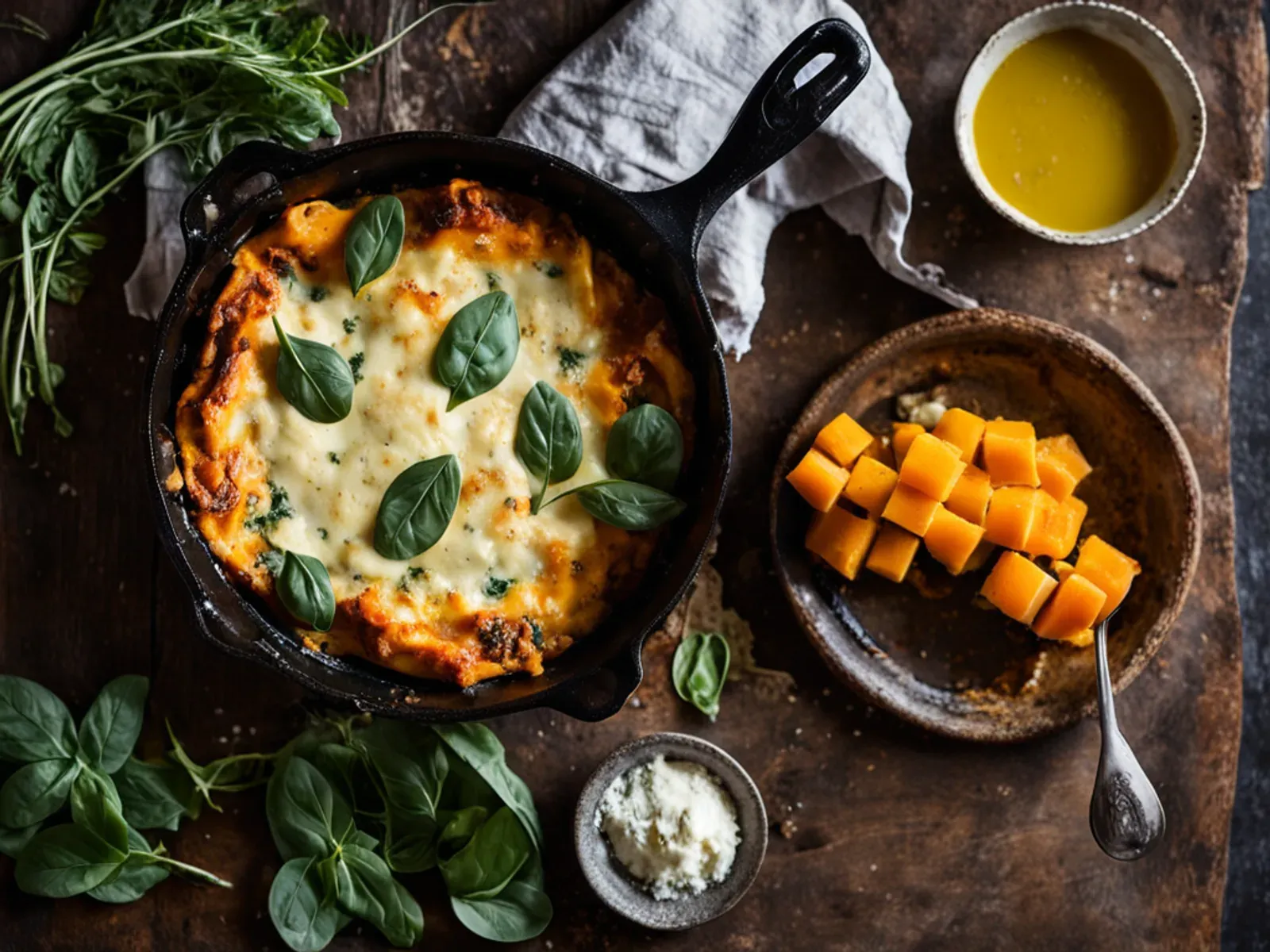
Butternut Squash Lasagna with Spinach Ricotta and Sage Béchamel is a vegetarian dinner recipe made with butternut squash (about 3 lb), olive oil, salt. It takes 125 minutes of hands-on time, plus 15 minutes resting, serves 8, and each serving has 569 calories, 28 g of protein and 5 g of fiber.
Roasting the squash before mashing it gives the purée more flavor and drives off water, so the lasagna holds its layers. Frying sage leaves in the butter first does two jobs: it flavors the béchamel and makes a crisp garnish. The sauce is kept a little loose on purpose, because the no-boil noodles soak up that liquid as they bake.
Ingredients
Squash
- 1 large1 kgbutternut squash (about 3 lb), peeled, seeded and cut into 1-inch cubes
- 2 tbsp27 golive oil
- 1 tsp6 gsalt
Sage béchamel
- 6 tbsp85 gunsalted butter
- 16 4 gfresh sage leaves
- 6 tbsp47 gall-purpose flour
- 4 cups976 gwhole milk, warmed
- ¼ tsp0.6 gground nutmeg
- 1 tsp6 gsalt
- ¼ tsp0.6 gblack pepper
Spinach ricotta
- 10 oz283 gfrozen chopped spinach, thawed and squeezed very dry
- 15 oz425 gwhole-milk ricotta
- 1 large50 gegg
- ½ cup40 gParmesan, finely grated
- 2 cloves6 ggarlic, minced
- ½ tsp3 gsalt
- ¼ tsp0.6 gblack pepper
Assembly
- 12 255 gno-boil (oven-ready) lasagna noodles
- 2 cups226 glow-moisture mozzarella, shredded
- ½ cup40 gParmesan, finely grated
Kit: 9x13-inch baking dish, rimmed baking sheet, medium saucepan, whisk, aluminum foil
Tips
- Squeeze the thawed spinach in a clean kitchen towel until no more water drips out. This matters more than anything else for keeping the slices from going watery.
- Warming the milk before adding it helps the béchamel come together smoothly with no lumps.
- You can assemble the lasagna up to 1 day ahead and refrigerate it covered. Add 10–15 minutes to the covered bake if it goes into the oven cold.
Swap ideas
- Use 5 oz fresh baby spinach, wilted in a dry pan and squeezed, instead of frozen
- Gives a fresher, brighter green layer. Squeeze out as much water as you can so the ricotta doesn't turn soupy.
- Use regular lasagna noodles boiled 2 minutes short of al dente instead of no-boil
- The noodles come out a bit firmer. Cut the covered bake to 30 minutes because they need less liquid.
- Replace half the mozzarella with shredded fontina
- Melts creamier and adds a nutty flavor that goes well with the squash and sage.
- Use acorn squash or 2 cups canned pumpkin purée instead of the butternut
- Acorn squash tastes much the same. Canned pumpkin skips the roasting but tastes milder, so add a pinch more salt and nutmeg.
The numbers
Nutrition per serving
569kcal per serving
Everything else · 8 servings per recipe
- Saturated fat
- 14.8 g 74%
- Sugars
- 10.5 g
- Sodium
- 1305 mg 57%
- Potassium
- 1013 mg 22%
- Calcium
- 710 mg 55%
- Iron
- 3.7 mg 21%
- Vitamin C
- 37 mg 41%
- Vitamin B12
- 1.25 µg 52%
% Daily Value on a 2,000 calorie diet. Calculated from USDA FoodData Central values for each ingredient; optional ingredients are excluded. Estimates vary with brands and portions.
Sources: Squash, winter, butternut, raw, Oil, olive, salad or cooking, Salt, table, Butter, salted, Sauge, fraîche (values from the Anses Ciqual 2017 table, as reproduced by laurentberta.com). No fresh sage entry exists in USDA FoodData Central., Wheat flour, white, all-purpose, enriched, bleached, Milk, reduced fat, fluid, 2% milkfat, with added vitamin A and vitamin D, Spices, nutmeg, ground, Spices, pepper, black, Spinach, raw, Cheese, ricotta, part skim milk, Egg, whole, raw, fresh, Cheese, parmesan, grated, Garlic, raw, Pasta, dry, enriched, Cheese, mozzarella, part skim milk
Method
Heat the oven to 425°F. Toss the squash cubes with the olive oil and 1 tsp salt, then spread them in a single layer on a rimmed baking sheet. Roast, flipping once, until fork-tender and browned at the edges, 30–35 minutes. Lower the oven to 375°F.
While the squash roasts, melt the butter in a medium saucepan over medium heat. Add the sage leaves and fry until they turn crisp and darker green and the butter smells nutty, 1–2 minutes. Lift the leaves onto a paper towel and leave the butter in the pan.
Whisk the flour into the sage butter and cook, whisking, for 1–2 minutes without letting it brown further. Slowly whisk in the warm milk until smooth. Simmer, whisking often, until the sauce coats the back of a spoon, 6–8 minutes. Take it off the heat, then stir in the nutmeg, salt, pepper and half the fried sage, crumbled. Keep the sauce slightly pourable; it will thicken as it cools.
In a bowl, mix the squeezed spinach, ricotta, egg, ½ cup Parmesan, garlic, salt and pepper until evenly combined.
Mash the roasted squash with a fork or potato masher until mostly smooth, leaving a few small pieces. Stir in ½ cup of the béchamel to loosen it into a spreadable purée.
Spread ½ cup béchamel over the bottom of a 9x13-inch baking dish and lay 3 noodles on top. Spread over a third of the squash, dollop on a third of the spinach ricotta and smooth it out, then add ½ cup mozzarella and about ½ cup béchamel. Repeat twice more. Top with the last 3 noodles, then cover them completely with the rest of the béchamel. Any exposed noodle edges will stay hard. Scatter the remaining ½ cup mozzarella and ½ cup Parmesan over the top.
Cover tightly with foil (lightly greased so the cheese doesn't stick) and bake at 375°F for 40 minutes, until the sauce bubbles at the edges and a knife slides easily through the noodles.
Uncover and bake until the top is golden in spots, 15–20 minutes more. Rest for 15 minutes so the layers set, then scatter the remaining crispy sage on top, slice and serve.
Storage: Refrigerate leftovers, covered, for up to 4 days. Reheat single slices covered at 350°F for 15–20 minutes, or in the microwave. To freeze, wrap baked slices well and freeze for up to 3 months, then thaw overnight in the fridge before reheating.
Questions
- How much protein is in butternut squash lasagna with spinach ricotta and sage béchamel?
- Each of the 8 servings has 28 g of protein, 5 g of fiber and 569 calories, calculated from USDA FoodData Central values for every ingredient.
- Is butternut squash lasagna with spinach ricotta and sage béchamel vegan?
- No, it's vegetarian rather than vegan because it contains unsalted butter and whole milk and whole-milk ricotta and egg and Parmesan and low-moisture mozzarella and Parmesan. Everything else in it is plant-based.
- How long does butternut squash lasagna with spinach ricotta and sage béchamel take to make?
- 30 minutes of prep and 95 minutes of cooking, so 125 minutes of hands-on time, plus 15 minutes of unattended resting.
- Can you make butternut squash lasagna with spinach ricotta and sage béchamel ahead?
- Refrigerate leftovers, covered, for up to 4 days. Reheat single slices covered at 350°F for 15–20 minutes, or in the microwave. To freeze, wrap baked slices well and freeze for up to 3 months, then thaw overnight in the fridge before reheating.
- What can I substitute in butternut squash lasagna with spinach ricotta and sage béchamel?
- Use 5 oz fresh baby spinach, wilted in a dry pan and squeezed, instead of frozen — gives a fresher, brighter green layer. squeeze out as much water as you can so the ricotta doesn't turn soupy.. Use regular lasagna noodles boiled 2 minutes short of al dente instead of no-boil — the noodles come out a bit firmer. cut the covered bake to 30 minutes because they need less liquid.. Replace half the mozzarella with shredded fontina — melts creamier and adds a nutty flavor that goes well with the squash and sage.. Use acorn squash or 2 cups canned pumpkin purée instead of the butternut — acorn squash tastes much the same. canned pumpkin skips the roasting but tastes milder, so add a pinch more salt and nutmeg..
- Does butternut squash lasagna with spinach ricotta and sage béchamel contain gluten?
- Yes — the ingredient list includes gluten. Check the labels on the products you buy if you're cooking for an allergy.
Nutrition is calculated from USDA data for every ingredient — how we work it out.
Published October 10, 2026 ·Italian