Lentil and Farro Jars with Roasted Beets and Maple Dijon
Make-ahead lunch jars layering maple-Dijon dressing, green lentils, chewy farro, roasted beets, toasted walnuts and arugula. Four jars, ready in about an hour.
- Prep
- 20 min
- Cook
- 35 min
- Rest
- 20 min
- Serves
- 4
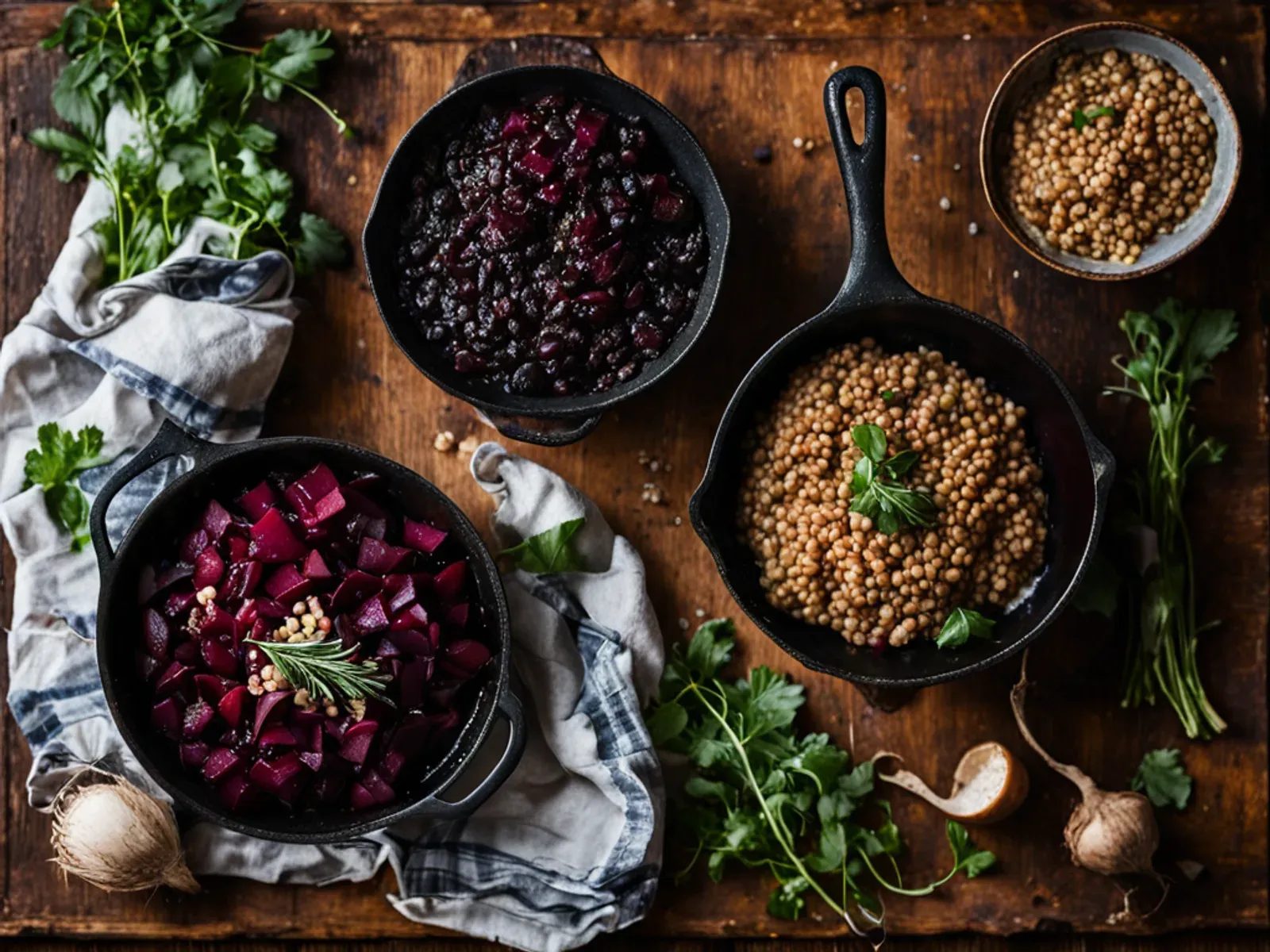
Lentil and Farro Jars with Roasted Beets and Maple Dijon is a vegan lunch recipe made with beets, olive oil, fine sea salt. It takes 55 minutes of hands-on time, plus 20 minutes resting, serves 4, and each serving has 570 calories, 19 g of protein and 11 g of fiber.
Cooking the lentils and farro separately is the whole trick here: lentils simmer gently so they stay whole, farro boils in salted water like pasta and gets drained, so nothing turns gluey by Wednesday. The maple-Dijon dressing goes in first and acts as a moat — grains sit in it and soak up flavor for days, while the arugula rides on top untouched until you shake the jar. Roasting the beets separately on their own sheet keeps the magenta out of everything else until serving.
Ingredients
Roasted beets
- 3 medium246 gbeets, peeled and cut into 1/2-inch cubes
- 1 tbsp14 golive oil
- ¼ tsp1.5 gfine sea salt
Grains and lentils
- 1 cup180 gpearled farro, rinsed
- ¾ cup144 gdried green or French lentils, rinsed and picked over
- 2 cloves6 ggarlic, lightly smashed
- 1 tsp6 gfine sea salt, for the cooking water
Maple Dijon dressing
- 3 tbsp41 gextra-virgin olive oil
- 1½ tbsp23 gDijon mustard
- 1 tbsp20 gpure maple syrup
- 2 tbsp30 gapple cider vinegar
- 1 tbsp15 glemon juice
- 1 clove3 ggarlic, grated or finely minced
- ½ tsp3 gfine sea salt
- ¼ tsp0.6 gblack pepper, freshly ground
To assemble
- ½ cup59 gwalnut halves, roughly chopped
- ½ medium55 gred onion, very thinly sliced
- ½ cup30 gflat-leaf parsley, roughly chopped
- 5 cups100 gbaby arugula
- 2 tbsp20 ghemp hearts, for sprinkling (optional)
Kit: rimmed baking sheet, 2 saucepans, fine-mesh sieve, 4 wide-mouth quart jars with lids
Tips
- Cool the grains and beets completely before assembling — warm layers release steam that wilts the arugula overnight.
- Wear gloves or rub your cutting board with a little oil before peeling beets if you'd rather not have pink hands.
- If you only have semi-pearled or whole farro, it needs 25–30 or 35–40 minutes respectively, and a soak overnight helps the whole grain.
- Pack the jars tight. Air pockets let the layers tumble and the dressing creep up into the greens.
Swap ideas
- Swap the farro for cooked quinoa or brown rice
- Makes the jars gluten-free; quinoa is softer, so expect less chew and a slightly looser layer.
- Use two 15-oz cans of drained lentils instead of dried
- Cuts 25 minutes off the cook; rinse well and season them a little more aggressively, as canned lentils taste flatter.
- Trade walnuts for toasted pumpkin seeds
- Keeps the recipe nut-free and adds a firmer crunch that survives longer in the fridge.
- Stir 2 tablespoons of tahini into the dressing
- Turns it creamy and mellows the Dijon; thin with a tablespoon of water so it still pours.
The numbers
Nutrition per serving
570kcal per serving
Everything else · 4 servings per recipe
- Saturated fat
- 2.9 g 14%
- Sugars
- 9.7 g
- Sodium
- 1144 mg 50%
- Potassium
- 875 mg 19%
- Calcium
- 117 mg 9%
- Iron
- 5.8 mg 32%
- Vitamin C
- 22 mg 24%
- Vitamin B12
- 0 µg 0%
% Daily Value on a 2,000 calorie diet. Calculated from USDA FoodData Central values for each ingredient; optional ingredients are excluded. Estimates vary with brands and portions.
Sources: Beets, raw, Oil, olive, salad or cooking, Salt, table, Farro, pearled, dry, raw (Foundation Foods), Lentils, raw, Garlic, raw, Mustard, prepared, yellow, Syrups, maple, Vinegar, cider, Lemon juice, raw, Spices, pepper, black, Nuts, walnuts, english, Onions, raw, Parsley, fresh, Arugula, raw
Method
Heat the oven to 425°F (220°C). Toss the cubed beets with 1 tablespoon olive oil and 1/4 teaspoon salt, spread them in a single layer on a rimmed baking sheet, and roast for 25–30 minutes, stirring once halfway, until the edges are darkened and a cube gives easily to a fork. Keep them on their own sheet so their color doesn't bleed into anything else. Let cool to room temperature.
While the beets roast, bring a saucepan of water to a boil with 1 teaspoon salt. Add the farro and boil uncovered, pasta-style, for 15–20 minutes, until the grains are tender with a distinct chew at the center. Drain in a sieve and spread on a plate to cool and dry out.
In a second saucepan, cover the lentils with 3 cups cold water and add the 2 smashed garlic cloves. Bring to a boil, then drop to a bare simmer and cook uncovered for 20–25 minutes, starting to taste at 18, until the lentils are creamy inside but still holding their shape. Drain, discard the garlic, and season with a pinch of salt while warm.
Toast the walnuts in a dry skillet over medium heat for 4–5 minutes, tossing often, until they smell nutty and look one shade darker. Tip them straight out of the pan onto a plate so they stop cooking.
Whisk the dressing: olive oil, Dijon, maple syrup, cider vinegar, lemon juice, grated garlic, 1/2 teaspoon salt and the black pepper, until it thickens into a glossy emulsion. Taste and adjust — it should read sharp and a little sweet, since the grains will mute it.
Divide the dressing among four wide-mouth quart jars, about 2 tablespoons each. Add the sliced red onion next so it softens in the vinegar as the jars sit.
Layer in this order, packing each layer down gently: lentils, then farro, then the cooled roasted beets, then the parsley and toasted walnuts. Everything must be fully cool before it goes in, or the greens will steam.
Top each jar with a loose handful of arugula, pressing it in just enough to seal the lid, and add hemp hearts if using. Refrigerate upright. To eat, shake the jar hard for a few seconds and tip it into a bowl, or eat straight from the jar.
Storage: Seal the jars and refrigerate upright for up to 4 days. The grains and lentils only improve by day two; the arugula stays crisp as long as it sits above the dressing. Shake into a bowl just before eating. Not suitable for freezing once assembled, though the cooked lentils and farro freeze well on their own for 2 months.
Questions
- How much protein is in lentil and farro jars with roasted beets and maple dijon?
- Each of the 4 servings has 19 g of protein, 11 g of fiber and 570 calories, calculated from USDA FoodData Central values for every ingredient.
- Is lentil and farro jars with roasted beets and maple dijon vegan?
- Yes. It contains no dairy, eggs, honey or other animal products.
- How long does lentil and farro jars with roasted beets and maple dijon take to make?
- 20 minutes of prep and 35 minutes of cooking, so 55 minutes of hands-on time, plus 20 minutes of unattended resting.
- Can you make lentil and farro jars with roasted beets and maple dijon ahead?
- Seal the jars and refrigerate upright for up to 4 days. The grains and lentils only improve by day two; the arugula stays crisp as long as it sits above the dressing. Shake into a bowl just before eating. Not suitable for freezing once assembled, though the cooked lentils and farro freeze well on their own for 2 months.
- What can I substitute in lentil and farro jars with roasted beets and maple dijon?
- Swap the farro for cooked quinoa or brown rice — makes the jars gluten-free; quinoa is softer, so expect less chew and a slightly looser layer.. Use two 15-oz cans of drained lentils instead of dried — cuts 25 minutes off the cook; rinse well and season them a little more aggressively, as canned lentils taste flatter.. Trade walnuts for toasted pumpkin seeds — keeps the recipe nut-free and adds a firmer crunch that survives longer in the fridge.. Stir 2 tablespoons of tahini into the dressing — turns it creamy and mellows the dijon; thin with a tablespoon of water so it still pours..
- Does lentil and farro jars with roasted beets and maple dijon contain gluten or tree nuts?
- Yes — the ingredient list includes gluten and tree nuts, in some cases as an optional ingredient you can leave out. Check the labels on the products you buy if you're cooking for an allergy.
Nutrition is calculated from USDA data for every ingredient — how we work it out.
Published September 21, 2026 ·Mediterranean