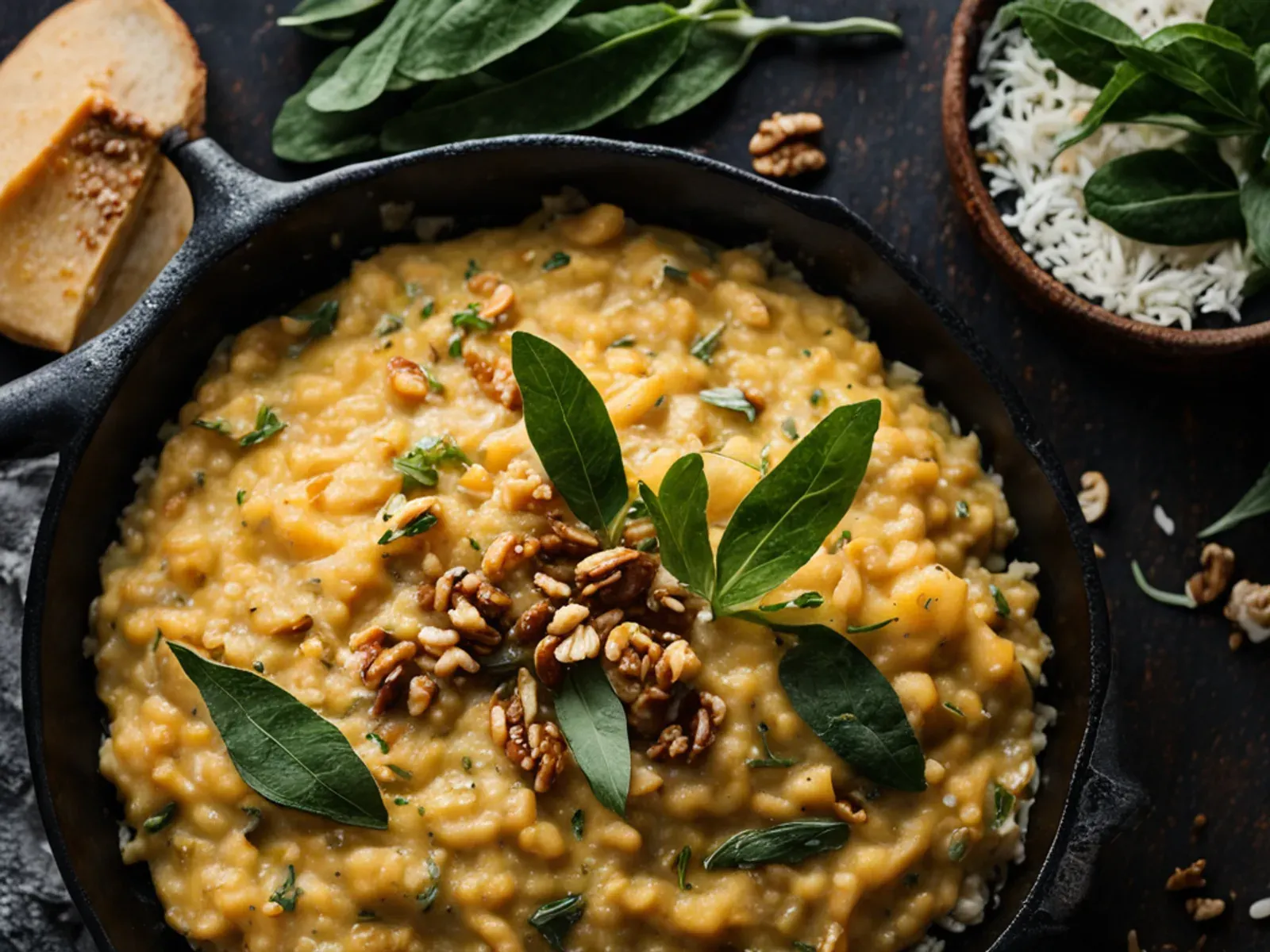
No-Stir Baked Butternut Squash Risotto with Crispy Sage
Creamy baked butternut squash risotto with no constant stirring. Roasted squash, miso and nutritional yeast make it rich and fully vegan, topped with crispy sage.
- Prep
- 20 min
- Cook
- 40 min
- Serves
- 4
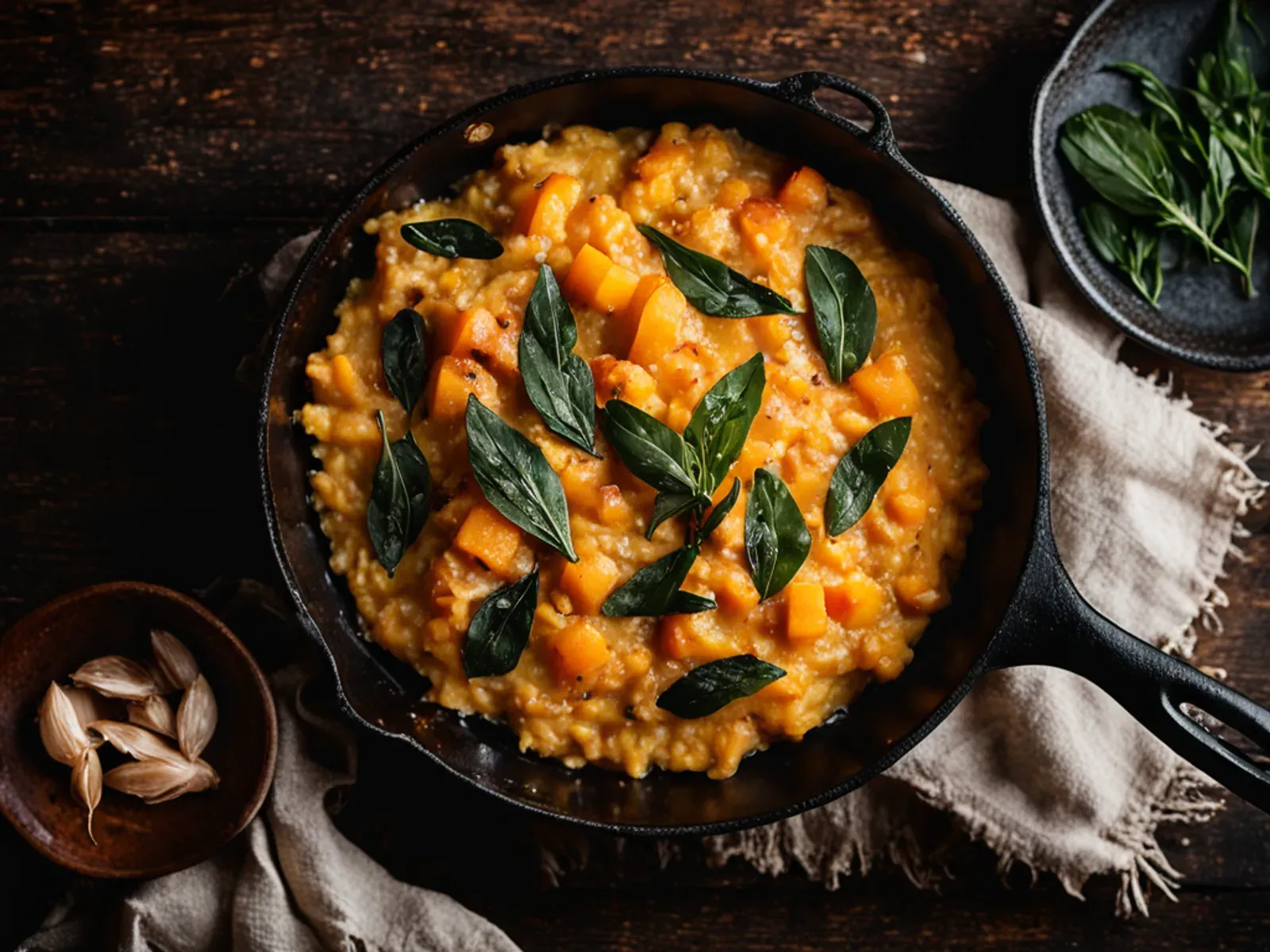
No-Stir Baked Butternut Squash Risotto with Crispy Sage is a vegan dinner recipe made with butternut squash, olive oil, salt. It takes 60 minutes of hands-on time, serves 4, and each serving has 600 calories, 11 g of protein and 6 g of fiber.
The rice bakes in a covered Dutch oven while the squash roasts on the rack below, so you get risotto without standing at the stove. The creaminess comes after baking: you stir hard with a last splash of hot broth to loosen the starch, then mash in half the roasted squash to make a silky sauce. White miso and nutritional yeast give it the salty, savory depth that parmesan and butter usually add, and a squeeze of lemon brightens it at the end.
A cooking method + dietary (hands-off no-stir oven bake, fully vegan with miso and nutritional yeast instead of parmesan and butter, roasted fresh butternut instead of pumpkin purée) take on our Creamy Pumpkin Sage Risotto with Parmesan and Toasted Walnuts.
Ingredients
Roasted squash
- 5 cups700 gbutternut squash, peeled and cut into 3/4-inch cubes (about 1 medium)
- 2 tbsp27 golive oil
- ½ tsp3 gsalt
Risotto
- 5½ cups1.32 kglow-sodium vegetable broth, kept hot, 4 1/2 cups go into the oven; save 1 cup for finishing
- 2 tbsp27 golive oil
- 2 large100 gshallots, finely minced
- 4 cloves12 ggarlic, minced
- 1½ cups270 garborio rice
- 2 tbsp34 gwhite (shiro) miso
- ¼ cup15 gnutritional yeast
- 1 tbsp15 gfresh lemon juice
- ½ tsp1.2 gblack pepper, freshly ground
- ¼ tsp1.5 gsalt, to taste
Crispy sage
- 3 tbsp41 golive oil
- 20 6 gfresh sage leaves
- 1 pinch0.4 gflaky salt
- 3 tbsp24 gtoasted pumpkin seeds, for serving (optional)
Kit: large oven-safe Dutch oven with lid, rimmed baking sheet, small skillet, saucepan
Tips
- Use hot broth. Cold broth slows the start of cooking and can leave the rice chalky in the middle.
- If your lid doesn't fit tightly, put a sheet of foil over the pot before adding the lid so the steam stays in.
- Different brands of miso and broth vary a lot in saltiness, so taste before adding salt at the end.
- Risotto keeps thickening as it sits, so it's better served a little loose than stiff.
Swap ideas
- Replace 1/2 cup of the broth with dry vegan white wine, added after toasting the rice and simmered until mostly gone
- Adds a classic tangy, bright note. Check that the label says vegan, since some wines are fined with animal products.
- Use acorn squash or kabocha instead of butternut
- Makes it a little drier and nuttier. Kabocha's skin can be left on.
- Stir in 2 cups baby spinach with the squash
- Adds greens and color. The spinach wilts in the heat of the rice.
- Replace the white miso with chickpea miso
- Makes it soy-free with a similar savory depth.
The numbers
Nutrition per serving
600kcal per serving
Everything else · 4 servings per recipe
- Saturated fat
- 3.5 g 18%
- Sugars
- 8.3 g
- Sodium
- 1790 mg 78%
- Potassium
- 932 mg 20%
- Calcium
- 121 mg 9%
- Iron
- 3.2 mg 18%
- Vitamin C
- 43 mg 47%
- Vitamin B12
- 14.08 µg 587%
% Daily Value on a 2,000 calorie diet. Calculated from USDA FoodData Central values for each ingredient; optional ingredients are excluded. Estimates vary with brands and portions.
Sources: Squash, winter, butternut, raw, Oil, olive, salad or cooking, Salt, table, Soup, vegetable broth, ready to serve, Shallots, raw, Garlic, raw, Roland Foods Arborio Rice (dry), label serving 1/4 cup dry (45 g): 160 kcal, 0 g fat, 0 mg sodium, 36 g carbs, 0 g fiber, 0 g sugars, 3 g protein, 30 mg potassium, 0.4 mg iron; converted to per 100 g. Ingredients: arborio rice., Miso, Nutritional Yeast Seasoning by BRAGG (fortified; legacy USDA Branded Foods entry as reproduced by NutritionValue.org), Lemon juice, raw, Spices, pepper, black, Sauge, fraîche (values from the Anses Ciqual 2017 table, as reproduced by laurentberta.com). No fresh sage entry exists in USDA FoodData Central.
Method
Put one oven rack in the center and one in the lower third, then heat the oven to 400°F. Toss the squash cubes with 2 tbsp olive oil and 1/2 tsp salt on a rimmed baking sheet, spread them in one layer, and roast on the lower rack. Meanwhile, bring the broth to a simmer in a saucepan and keep it hot over low heat.
Heat 2 tbsp olive oil in the Dutch oven over medium heat. Add the shallots and a pinch of salt and cook, stirring, until soft and translucent, 3–4 minutes. Add the garlic and cook until fragrant, about 30 seconds.
Add the rice and stir until every grain is coated with oil and the edges look translucent, about 2 minutes. Pour in 4 1/2 cups of the hot broth, stir once to scrape the bottom, and bring it back to a simmer.
Cover tightly and bake on the center rack for 22–25 minutes, until most of the broth is absorbed and the rice is tender with a slight bite in the center. Roast the squash for 25–30 minutes total, flipping once halfway, until it is fork-tender and browned at the edges.
While everything bakes, heat 3 tbsp olive oil in a small skillet over medium heat until a sage leaf sizzles right away when you add it. Fry the sage in a single layer until the leaves are darker green and turn crisp, 30–60 seconds. Move them to a paper towel, sprinkle with flaky salt, and save the sage oil.
Whisk the miso with 1/4 cup of the remaining hot broth until smooth. Take the Dutch oven out (the handles will be very hot) and set it on the stove. Add the miso mixture, the rest of the reserved broth and the nutritional yeast, then stir hard for 2–3 minutes until the rice turns loose and creamy.
Mash about half the roasted squash with a fork and stir it into the risotto so it melts into a sauce. Gently fold in the rest of the cubes. Stir in the lemon juice and pepper, then taste and add salt if needed. If it has thickened, loosen it with a splash of hot water so it spreads slowly when spooned onto a plate.
Serve right away in warm bowls, topped with crispy sage, a drizzle of the sage oil and toasted pumpkin seeds if you like.
Storage: Cool quickly and refrigerate in an airtight container for up to 4 days. Reheat on the stove or in the microwave with a few tablespoons of broth or water, stirring until creamy again. Keep the crispy sage in a separate container at room temperature for up to 2 days. Freezing isn't recommended because the rice turns grainy.
Questions
- How much protein is in no-stir baked butternut squash risotto with crispy sage?
- Each of the 4 servings has 11 g of protein, 6 g of fiber and 600 calories, calculated from USDA FoodData Central values for every ingredient.
- Is no-stir baked butternut squash risotto with crispy sage vegan?
- Yes. It contains no dairy, eggs, honey or other animal products.
- How long does no-stir baked butternut squash risotto with crispy sage take to make?
- 20 minutes of prep and 40 minutes of cooking, so 60 minutes of hands-on time.
- Can you make no-stir baked butternut squash risotto with crispy sage ahead?
- Cool quickly and refrigerate in an airtight container for up to 4 days. Reheat on the stove or in the microwave with a few tablespoons of broth or water, stirring until creamy again. Keep the crispy sage in a separate container at room temperature for up to 2 days. Freezing isn't recommended because the rice turns grainy.
- What can I substitute in no-stir baked butternut squash risotto with crispy sage?
- Replace 1/2 cup of the broth with dry vegan white wine, added after toasting the rice and simmered until mostly gone — adds a classic tangy, bright note. check that the label says vegan, since some wines are fined with animal products.. Use acorn squash or kabocha instead of butternut — makes it a little drier and nuttier. kabocha's skin can be left on.. Stir in 2 cups baby spinach with the squash — adds greens and color. the spinach wilts in the heat of the rice.. Replace the white miso with chickpea miso — makes it soy-free with a similar savory depth..
- Does no-stir baked butternut squash risotto with crispy sage contain gluten?
- Yes — the ingredient list includes gluten. Check the labels on the products you buy if you're cooking for an allergy.
Nutrition is calculated from USDA data for every ingredient — how we work it out.
Published September 26, 2026 ·Italian